



For Customers
VERTICALS
COMPANY
SOLUTIONS
PARTNERSHIPS
POLICIES
Washington D.C. Office
1100 15th St NWWashington, D.C. 20005
New York Office
191 Main St #595Port Washington, NY 11050 USA











The average American has 22 connected devices*, providing both opportunities and challenges for advertisers. The key to effectively reaching your audience throughout their journey is the ability to recognize voters across channels and devices and unify identifiers to a single profile.
An identity graph links disparate identifiers, both online and offline, to allow advertisers to recognize an individual consumer across all of their devices, and create a unified and accurate profile of each consumer. These profiles help advertisers understand and engage with their target audience.
Identity graphs are important because today’s consumer journeys are more fragmented than ever. For example, a consumer may begin looking at a product or researching a topic on their mobile device, continue their research on another device from a different location, like on a laptop at work, and finally, purchase a product, book a hotel room, or schedule an appointment from another device, like a tablet. In order to message this consumer, an advertiser must be able to identify them across these touchpoints and reach them with effective messaging.
Additionally, third party cookie deprecation makes a varied and scaled identity graph important for the future of digital advertising. Marketers can no longer rely only on 3rd party cookies to identify, track and measure their campaigns.
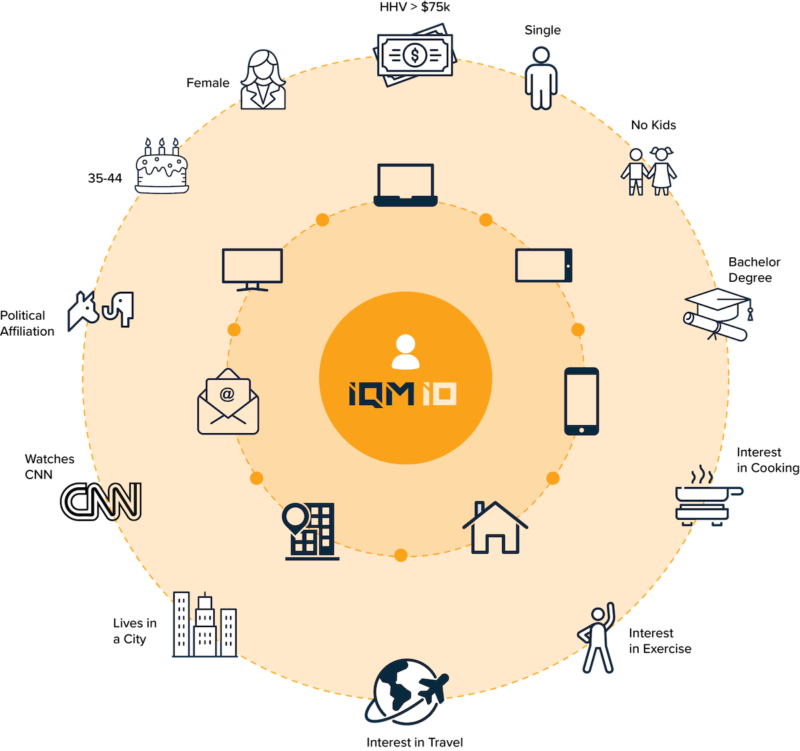
IQM collects billions of data signals from various sources (see below) and maps these signals from multiple consumer identities into pseudonymized identifiers.
Our machine learning model identifies pseudonymized identifiers and leverages both probabilistic and deterministic methodologies to make connections between them, thereby concluding they are associated with one individual.
That individual is given an IQM ID, a person-level identifier that can now be targeted via programmatic campaigns.
Additionally, we can conclude that multiple individuals come from the same household. To do this, we identify multiple IQM IDs that are consistently associated with the same signals, such as IP address, and deduce that they are likely from the same household. These IQM IDs are grouped together and given one IQM HH ID (household-level identifier).
The graph is updated daily for minor changes based on signals observed in the previous 24 hours. It also undergoes a major refresh monthly, to ensure the IP addresses, devices and cookies observed are still active and reachable.
Yes. IQM does not track any device or cookie with “do not track” setting enabled and follows CCPA and GDPR guidelines.
Campaign Planning – ID graph enables estimation of audience size and reach, especially helpful when applying demographic or geographic filters to your audience
Targeting:
Insights & Reporting:
IQM ID is a pseudonymized universal Identifier that is tied to devices and cookies in IQM’s Identity Graph. Each IQM_ID can be thought of as related to an individual person and having demographic, psychographic segments attributed to it. Both links to devices/cookies as well as segment attribution may vary for IQM_ID time to time as more signals are received and learned over a period of time.
IQM HH ID is a pseudonymized collection of IQM IDs which are part of the same household within the IQM Identity Graph. IQM HH ID has segment attribution at household level. E.g. household income, family size and mix etc.
● Cookies
● Device IDs
● Hashed emails
● IP addresses
● Hashed Phone Numbers
● Hashed household addresses
● Internal Ids – IQM ID & IQM HH ID
Signals
● Wifi address
● Time stamp
● Geolocation
● Browser attributes
● Device attributes
● User agent
● Contextual data
● Browse and click stream data
● Census
● From Open RTB data
● Geo-location data provider
● IP data providers
● From first party publishers (web and app)
● From DMP Partners
● 250M+ US individuals (about 75% of US population)
● 102M+ US Households (about 78% of US households)
Currently, it only covers the US.
Pseudonymization is a process used in data protection that replaces personally identifiable information (PII) with a pseudonym. The data has been de-identified, but can be reversed and re-identified. This is different from anonymized data in that it has been changed so that re-identification is impossible.
Deterministic methodologies rely on strict, exact matching criteria to link identities. For example, if two records have the same email address, they are considered the same identity. Deterministic is ideal for accuracy, but scale is often very limited.
Probabilistic methodologies use likelihood based on similarities and patterns in observed signals to establish connections between identifiers. While probabilistic has the potential to be less accurate, it provides much greater scale for the identity graph.
IQM’s graph employs a combination of both methodologies to strike a balance between accuracy and scale.
1100 15th St NWWashington, D.C. 20005
191 Main St #595Port Washington, NY 11050 USA

 Screens Are Everywhere—Programmatic Makes Sure Your Ads Are Too